
Data mining is the systematic process of discovering hidden patterns, correlations, and actionable insights within vast datasets. Often referred to as Knowledge Discovery in Databases (KDD), it sits at the intersection of statistics, machine learning, and database systems to transform raw data into meaningful intelligence.
The Core Process: How Data Mining Works
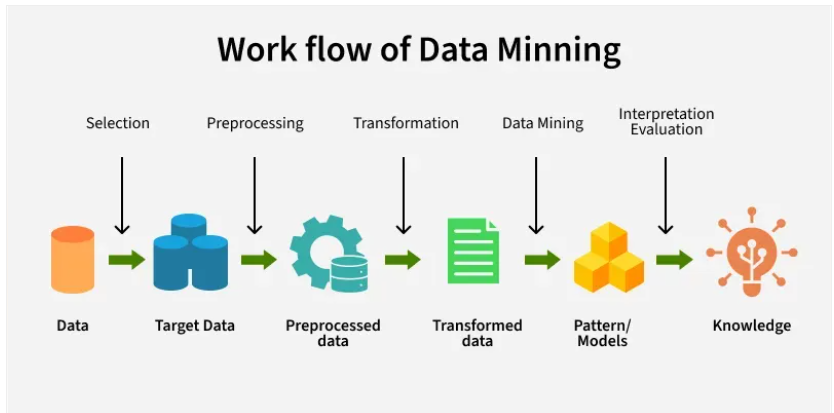
The journey from raw data to insight typically follows a structured lifecycle:
- Data Selection and Collection: Identifying relevant data sources such as Data Warehouses, databases, or streaming network data.
- Preprocessing and Cleaning: Removing noise, handling missing values, and ensuring the dataset is concise enough for efficient mining.
- Transformation: Organizing data into appropriate formats (e.g., Normalization) for algorithmic analysis.
- Data Mining: Applying advanced algorithms to extract patterns.
- Interpretation and Evaluation: Visualizing results and measuring their validity to support strategic decision-making.
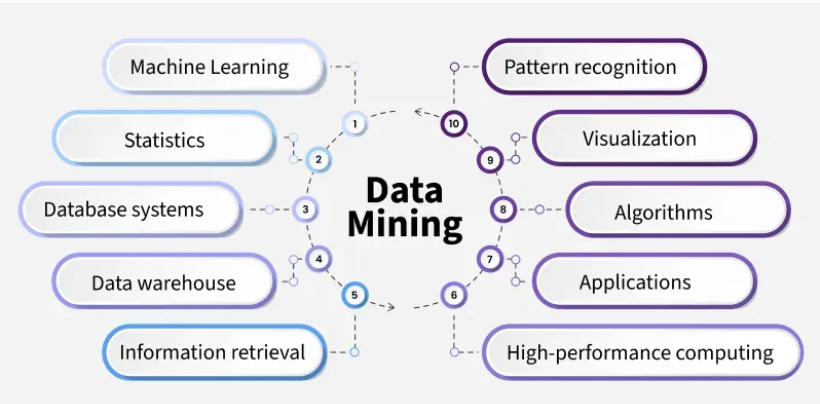
Essential Techniques and Algorithms
Modern data mining relies on several key functional categories:
- Classification: Assigning data points to predefined categories using algorithms like Random Forest, Decision Trees, and Support Vector Machines (SVM).
- Clustering: Grouping similar data points together without prior labels to identify natural structures.
- Regression: Modeling relationships between variables to forecast numerical values.
- Association Rule Mining: Uncovering “if-then” relationships, such as identifying products frequently bought together.
- Anomaly Detection: Identifying unusual patterns that deviate from the norm, crucial for fraud detection.
Real-World Applications
Data mining has become indispensable across various sectors:
- Business and Marketing: Companies use Predictive Analytics to understand customer behavior, optimize product placement, and increase sales.
- Education (EDM): Researchers analyze student performance data to predict outcomes and improve teaching effectiveness.
- Finance: Financial institutions leverage mining for Fraud Detection and risk assessment.
- Environmental Science: Scientists mine remote sensing data to predict natural disasters like floods, tsunamis, and droughts.
Challenges and Ethical Considerations
Despite its benefits, data mining faces significant hurdles. Inaccurate techniques can lead to flawed models and incorrect business decisions. Furthermore, the use of personally identifiable information raises critical Privacy and Ethical Concerns, requiring organizations to adhere strictly to governance standards and data protection laws.
Copyright@hcispace.com